GPT vs Claude vs Gemini: Which AI Model Should a Founder Choose First?
What Are GPT, Claude, and Gemini?
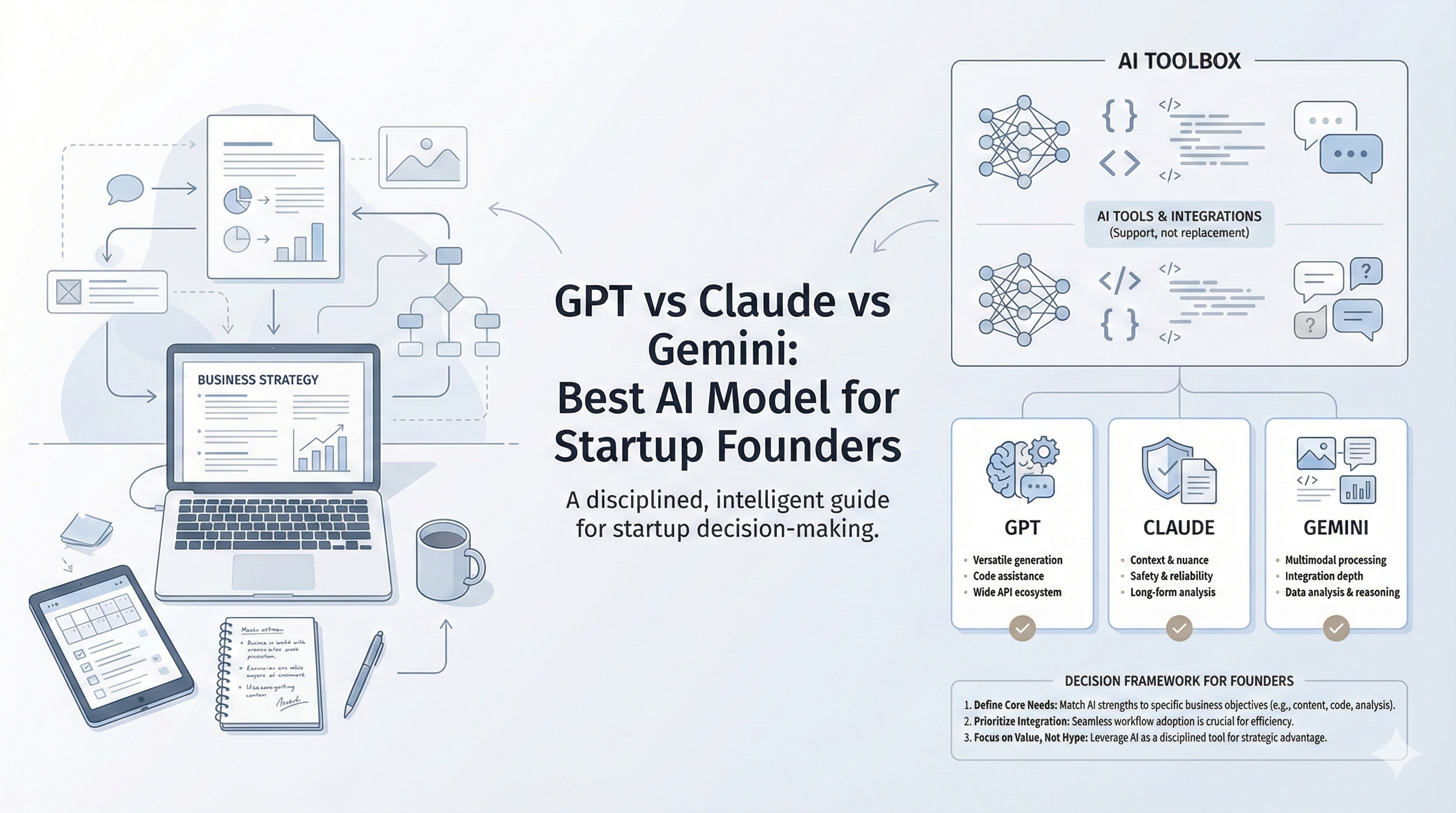
GPT vs Claude vs Gemini represents the three leading AI language models available to founders today. GPT (by OpenAI) excels at versatile content creation, Claude (by Anthropic) prioritizes safe and nuanced reasoning, and Gemini (by Google) integrates seamlessly with Google’s ecosystem. Each offers distinct advantages for startup AI strategy depending on your business requirements, budget constraints, and technical implementation needs.
The Founder’s Dilemma: Choosing the Right AI Model
As a founder, you’re bombarded with AI options. Every pitch deck mentions artificial intelligence, and every competitor claims to be “AI-powered.” But when it comes to actually implementing AI tools for founders, the choice between GPT vs Claude vs Gemini can feel overwhelming.
The reality is that your first AI model choice matters significantly. It influences your product development speed, operational costs, customer experience quality, and even your team’s workflow efficiency. Choose wrong, and you might waste months of development time and thousands in API costs. Choose right, and you’ll gain a competitive advantage that compounds over time.
This guide cuts through the marketing noise to help you make an informed decision about the best AI model for startups based on real-world use cases, pricing structures, and performance benchmarks.
Understanding Each AI Model
GPT (OpenAI): The Versatile Pioneer
OpenAI’s GPT models, particularly GPT-4 and the latest GPT-4 Turbo, have become synonymous with AI for many users. As the most widely adopted AI models for business, GPT excels in several key areas.
Strengths:
- Extensive third-party integration ecosystem with thousands of plugins and tools
- Strong performance across creative writing, code generation, and analytical tasks
- Robust API documentation and developer community support
- Flexible fine-tuning options for specialized business applications
- Multimodal capabilities including image understanding and generation
Limitations:
- Higher pricing compared to alternatives for equivalent token usage
- Occasional verbosity that increases processing costs
- Content filtering can be overly cautious for certain business contexts
- Response quality can vary between model versions
Best For: Founders building customer-facing chatbots, content generation platforms, or products requiring extensive third-party integrations.
Claude (Anthropic): The Thoughtful Reasoner
Claude, developed by Anthropic, has rapidly gained traction among founders who prioritize nuanced reasoning and ethical AI deployment. When comparing GPT vs Claude vs Gemini, Claude stands out for its distinctive approach to AI safety and output quality.
Strengths:
- Exceptional performance on complex reasoning and analytical tasks
- Longer context windows (up to 200,000 tokens) enabling processing of entire codebases or documents
- More concise responses that reduce token costs over time
- Strong coding capabilities with fewer hallucinations
- Thoughtful handling of ambiguous queries without overconfident responses
Limitations:
- Smaller ecosystem of pre-built integrations compared to GPT
- More recent market entry means fewer case studies and tutorials
- API availability varies by region
- Limited image generation capabilities
Best For: Startups focused on data analysis, technical documentation, research synthesis, or applications requiring high accuracy and reliability.
Gemini (Google): The Integrated Powerhouse
Google’s Gemini models leverage the tech giant’s vast infrastructure and data ecosystem. For founders already embedded in Google’s workspace tools, Gemini offers unique advantages in the AI tools for founders landscape.
Strengths:
- Native integration with Google Workspace, Search, and Cloud services
- Competitive pricing with generous free tiers for experimentation
- Multimodal capabilities built from the ground up
- Fast inference speeds suitable for real-time applications
- Access to Google’s knowledge graph for fact-checking
Limitations:
- Shorter track record means less community knowledge
- Performance can vary across different task types
- Privacy considerations for businesses handling sensitive data
- API features still maturing compared to more established competitors
Best For: Founders building products that benefit from Google ecosystem integration, need real-time search capabilities, or require competitive pricing at scale.
Decision Framework: Matching AI Models to Startup Needs
 Decision Framework: Matching AI Models to Startup Needs
Consider Your Primary Use Case
The best AI model for startups depends heavily on your specific application. Here’s how to think about matching models to use cases:
Content Generation and Marketing: If your startup needs blog posts, social media content, or marketing copy, GPT’s creative writing capabilities make it the frontrunner. Its training on diverse internet content gives it versatility across tones and styles.
Technical Analysis and Coding: For startups building developer tools, conducting data analysis, or requiring code review capabilities, Claude’s reasoning depth and extended context windows provide significant advantages. Its ability to process entire repositories makes it invaluable for technical founders.
Enterprise Integration: If your business model involves selling to enterprises already using Google Workspace, Gemini’s native integration reduces friction and accelerates adoption. This matters more than raw performance for certain B2B applications.
Evaluate Your Budget Structure
Pricing models differ substantially across GPT vs Claude vs Gemini, and your usage patterns will determine cost-effectiveness:
GPT Pricing: OpenAI charges per token with tiered pricing. High-volume applications can become expensive, but the extensive API features justify costs for many use cases. Budget approximately $0.03 per 1K tokens for GPT-4 output.
Claude Pricing: Anthropic’s pricing is competitive with volume discounts. The model’s conciseness means fewer tokens per interaction, potentially reducing overall costs despite similar per-token rates. The longer context window eliminates costs associated with multiple API calls.
Gemini Pricing: Google offers aggressive pricing with free tiers suitable for prototyping and early-stage startups. Production pricing remains competitive, especially for startups already using Google Cloud infrastructure.
Assess Technical Implementation Requirements
Your team’s technical capabilities influence which AI model integrates most smoothly into your startup AI strategy:
Developer Experience: GPT offers the most mature documentation and community resources. You’ll find solutions to common problems quickly. Claude and Gemini are catching up but require more independent problem-solving.
Latency Requirements: If your application demands sub-second responses (like real-time customer support), test all three models with your specific use case. Performance varies based on prompt complexity and server load.
Scaling Considerations: Consider rate limits, token limits, and concurrent request capabilities. GPT generally offers more flexible enterprise scaling options, while Gemini provides advantages for startups scaling within Google Cloud.
Practical Testing Approach
Before committing to one of these AI models for business, run this three-step validation:
Week 1 – Parallel Testing: Implement identical prompts across all three models using their free tiers or trial periods. Document response quality, speed, and cost for your top five use cases.
Week 2 – Edge Case Exploration: Test each model with your most challenging scenarios—ambiguous queries, technical edge cases, or domain-specific terminology. Note where each model struggles or excels.
Week 3 – Team Feedback: Have your team interact with each model in realistic workflows. Adoption depends partly on subjective factors like response style and interface usability.
The Hybrid Strategy: Why Choose Just One?
Many successful startups don’t limit themselves to a single model in their AI tools for founders toolkit. Consider a hybrid approach:
Use GPT for customer-facing interactions where brand voice and creativity matter. Deploy Claude for internal analysis, code review, and technical documentation where accuracy is paramount. Leverage Gemini for tasks requiring Google ecosystem integration or real-time information.
This multi-model strategy does increase integration complexity but provides flexibility to optimize for performance and cost across different use cases.
Making Your Final Decision
When evaluating GPT vs Claude vs Gemini, prioritize these factors in order:
- Use Case Fit: Does the model excel at your primary application?
- Budget Alignment: Can you afford the pricing at your projected scale?
- Integration Effort: How quickly can your team implement and maintain it?
- Future Flexibility: Does it support your product roadmap for the next 12-18 months?
For most founders starting their startup AI strategy, the recommendation is to begin with GPT due to its ecosystem maturity and versatility, while keeping Claude in your toolkit for specialized analytical tasks. As your startup scales and use cases diversify, expanding to include multiple models becomes increasingly advantageous. The best AI model for startups isn’t about choosing the “winner” in the GPT vs Claude vs Gemini debate—it’s about selecting the right tool for your specific business context, then adapting as your needs evolve.

.png)
Comments
Post a Comment