Generative AI for Business Automation
Generative AI for Business Automation
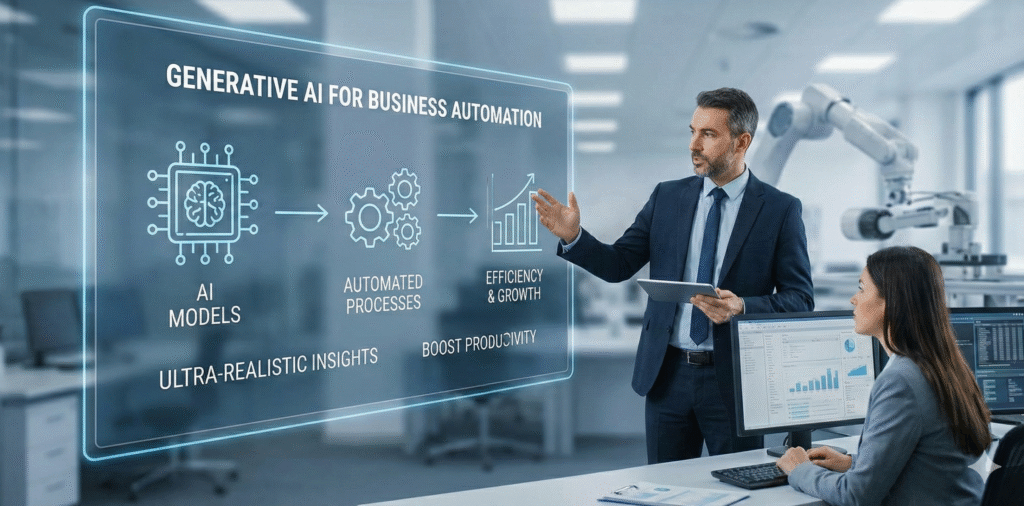
Generative AI for Business automation refers to artificial intelligence systems that create original content, code, designs, and solutions to automate repetitive tasks and complex workflows. This technology enables companies to leverage AI automation tools to generate human-like outputs—from customer responses to data analysis—reducing manual effort while improving accuracy and speed. Generative AI for Business transforms how organizations operate by intelligently handling tasks that previously required significant human intervention.
The Rise of AI in Modern Business Operations
The business landscape is experiencing a fundamental shift as Generative AI technologies mature and become more accessible. Organizations across industries are discovering that traditional automation has limitations—it can handle structured, rule-based tasks but struggles with creativity, nuance, and adaptation. This is where Generative AI for Business automation stands apart.
Unlike conventional automation that follows predetermined scripts, generative models learn from vast datasets to produce novel outputs. Whether drafting marketing copy, generating code, designing graphics, or analyzing complex data patterns, these AI automation tools bring unprecedented flexibility to business processes.
Companies implementing Generative AI for Business solutions report significant improvements in operational efficiency. Tasks that once consumed hours now complete in minutes, freeing employees to focus on strategic initiatives that require human judgment and creativity.
Key Applications of Generative AI for Business Automation
Content Creation and Marketing Automation
Generative AI productivity tools excel at creating diverse marketing content at scale. Businesses use these systems to generate blog posts, social media updates, email campaigns, and product descriptions while maintaining brand voice consistency. Marketing teams can produce personalized content for different audience segments without proportionally increasing workload.
The AI automation benefits extend beyond volume—these tools analyze performance data to refine messaging strategies, suggest optimal posting times, and even A/B test different content variations automatically.
Customer Service Enhancement
Intelligent chatbots powered by Generative AI handle customer inquiries with remarkable sophistication. These systems understand context, interpret intent, and generate relevant responses that feel genuinely conversational. They resolve common issues instantly, escalate complex problems appropriately, and operate 24/7 without fatigue.
The result? Reduced response times, improved customer satisfaction scores, and significant cost savings on support operations.
Software Development Acceleration
AI automation tools now assist developers by generating code snippets, identifying bugs, suggesting optimizations, and even creating entire functions from natural language descriptions. This doesn't replace programmers but amplifies their productivity, allowing them to tackle more ambitious projects with existing resources.
Development teams using Generative AI for Business automation report 30-50% faster coding cycles and fewer routine errors.
Data Analysis and Reporting
Analyzing complex datasets and extracting actionable insights traditionally required specialized analysts spending considerable time. Generative AI systems now automate much of this process—identifying patterns, generating visualizations, and producing comprehensive reports in natural language that stakeholders can immediately understand.
Measurable AI Automation Benefits for Organizations
Cost Reduction and Resource Optimization
Implementing Generative AI for Business automation delivers substantial cost savings. Organizations reduce spending on repetitive tasks while reallocating human talent to higher-value activities. The technology works continuously without overtime costs, benefits, or office space requirements.
Financial services firms report reducing operational costs by 25-40% through strategic AI automation deployment.
Enhanced Productivity and Efficiency
Generative AI productivity tools eliminate bottlenecks in workflows. Tasks that previously created delays—waiting for content approval, scheduling meetings, processing routine requests—now happen automatically. Employees accomplish more in less time, and project timelines compress significantly.
The productivity gains compound across departments, creating organizational-level transformation rather than isolated improvements.
Improved Accuracy and Consistency
Human error inevitably affects manual processes, especially repetitive ones. AI automation tools maintain consistent quality standards regardless of volume or complexity. They follow established guidelines precisely, apply rules uniformly, and flag anomalies for human review.
This reliability proves especially valuable in compliance-sensitive industries where mistakes carry serious consequences.
Scalability Without Proportional Investment
Traditional business scaling requires hiring more employees, expanding facilities, and increasing overhead. Generative AI for Business automation scales differently—handling increased workload with minimal additional investment. Companies can pursue growth opportunities without the operational constraints that previously limited expansion.
Selecting the Right AI Automation Tools
Assessing Business Requirements
Successful Generative AI implementation begins with clear understanding of specific needs. Which processes consume excessive time? Where do errors frequently occur? What tasks prevent employees from focusing on strategic work?
Prioritize automation opportunities based on potential impact, implementation complexity, and alignment with business objectives.
Evaluating Technology Options
The AI automation tools market offers numerous solutions with varying capabilities. Consider factors like integration with existing systems, customization flexibility, vendor support quality, security features, and total cost of ownership.
Request demonstrations, pilot small-scale implementations, and gather feedback from actual users before committing to enterprise-wide deployment.
Implementation Best Practices
Successful Generative AI for Business automation requires thoughtful planning. Start with limited scope projects that deliver quick wins and build organizational confidence. Involve employees early, addressing concerns about job security and providing training on working alongside AI systems.
Monitor performance metrics closely, refine configurations based on real-world results, and document processes for knowledge sharing across teams.
Overcoming Implementation Challenges
Managing Change Resistance
Introducing Generative AI productivity tools often triggers employee anxiety about displacement. Address this proactively through transparent communication about automation goals—emphasizing augmentation rather than replacement. Involve staff in selecting and refining tools, creating ownership rather than resentment.
Ensuring Data Quality and Security
Generative AI systems require quality training data to perform effectively. Poor data inputs produce unreliable outputs. Establish data governance frameworks, implement security protocols for sensitive information, and regularly audit AI system outputs for accuracy and bias.
Balancing Automation and Human Judgment
While AI automation benefits are substantial, certain decisions require human oversight. Define clear boundaries for autonomous operation versus human-in-the-loop processes. Critical decisions, creative strategy, and ethically complex situations should retain meaningful human involvement.
The Future of Generative AI in Business
Generative AI for Business automation continues evolving rapidly. Emerging capabilities include multi-modal systems that work across text, images, audio, and video simultaneously. Improved reasoning abilities enable more sophisticated problem-solving and decision support.
Organizations investing in AI automation tools today position themselves advantageously for tomorrow's competitive landscape. The technology becomes more powerful, accessible, and essential to business success with each advancement.
Conclusion
Generative AI for Business automation represents a transformative opportunity for organizations seeking competitive advantage through operational excellence. The AI automation benefits—including cost reduction, enhanced productivity, improved accuracy, and effortless scalability—make compelling cases for strategic implementation.
Success requires thoughtful selection of Generative AI productivity tools, careful planning, employee engagement, and ongoing optimization. Companies embracing this technology today will lead their industries tomorrow, while those delaying risk falling behind competitors already leveraging AI-powered automation to work faster, smarter, and more efficiently.
The question isn't whether to adopt Generative AI for Business automation—it's how quickly and effectively your organization can implement it to maximize competitive advantage.


.png)
Comments
Post a Comment