Ethical AI in 2026: Balancing Innovation and Responsibility

As artificial intelligence continues to reshape our world, ethical AI in 2026 has become more than just a buzzword—it’s a fundamental requirement for sustainable technological progress. The rapid advancement of AI systems has brought unprecedented opportunities alongside critical challenges that demand our immediate attention. Understanding how to balance innovation with responsibility is essential for creating AI systems that benefit humanity while minimizing potential harms.
What is Ethical AI?
Ethical AI refers to the development and deployment of artificial intelligence systems that adhere to moral principles, societal values, and established ethical frameworks. In 2026, ethical AI encompasses fairness, transparency, accountability, privacy protection, and the mitigation of bias in machine learning algorithms. It’s about ensuring that AI systems are designed with human welfare as the primary consideration, not as an afterthought. The concept extends beyond simple compliance with regulations. True ethical AI requires a proactive approach to identifying potential harms, engaging diverse stakeholders, and continuously evaluating the societal impact of AI technologies as they evolve and scale.
Why Ethical AI Matters in 2026
The importance of ethical artificial intelligence has reached a critical juncture in 2026. AI systems now influence decisions in healthcare diagnosis, criminal justice, financial lending, employment screening, and educational opportunities. When these systems operate without proper ethical guardrails, they can perpetuate discrimination, invade privacy, and make decisions that profoundly affect human lives without adequate oversight. Recent high-profile incidents have highlighted the consequences of neglecting AI ethics. Facial recognition systems have shown racial bias, hiring algorithms have discriminated against qualified candidates, and predictive policing tools have reinforced existing societal inequalities. These failures underscore why responsible AI development must be prioritized alongside technical innovation.
Key Principles of Ethical AI in 2026
Fairness and Bias Mitigation
AI fairness remains one of the most pressing challenges in 2026. Ensuring that AI systems treat all individuals and groups equitably requires: Active identification and correction of biases in training data that reflect historical discrimination or underrepresentation of certain populations. Regular auditing of AI model outputs to detect disparate impacts across different demographic groups. Implementation of fairness metrics that align with legal standards and societal expectations of equal treatment. Organizations must recognize that fairness is not a one-time achievement but an ongoing commitment requiring continuous monitoring and adjustment as AI systems interact with dynamic real-world environments.
Transparency and Explainability
AI transparency has evolved significantly as stakeholders demand to understand how AI systems reach their conclusions. In 2026, explainable AI is not just a technical feature but a fundamental right, especially when AI decisions affect access to opportunities or resources. This includes providing clear documentation about AI system capabilities and limitations, offering understandable explanations for individual decisions that affect people, and maintaining transparency about when AI is being used versus human judgment. The “black box” problem that plagued earlier AI systems is increasingly unacceptable in contexts where human rights and dignity are at stake.
Accountability and Governance
AI accountability establishes who is responsible when AI systems cause harm or make errors. In 2026, robust governance frameworks include: Clear assignment of responsibility to human decision-makers rather than diffusing accountability to the technology itself. Established audit trails that document AI system decisions and the data used to train them. Accessible mechanisms for individuals to challenge AI decisions and seek redress when harmed. Effective AI governance requires collaboration between technologists, policymakers, ethicists, and affected communities to create accountability structures that are both technically feasible and socially meaningful.
Privacy and Data Protection
AI privacy concerns have intensified as systems become more sophisticated at extracting insights from personal information. Ethical AI in 2026 demands: Strict adherence to data minimization principles, collecting only information necessary for specified purposes. Implementation of privacy-preserving techniques like federated learning and differential privacy. Clear consent mechanisms that give individuals meaningful control over their data. The intersection of AI and privacy extends beyond regulatory compliance to respecting human autonomy and preventing surveillance creep that could chill free expression and association.
Balancing Innovation and Responsibility
The Innovation Imperative
The case for AI innovation remains compelling in 2026. Artificial intelligence offers transformative potential for addressing global challenges including climate change modeling, disease detection and treatment, educational personalization, and resource optimization. Overly restrictive approaches could slow progress on these critical applications and cede competitive advantages to jurisdictions with fewer safeguards. Innovation thrives in environments that encourage experimentation, accept calculated risks, and allow for rapid iteration. The question is not whether to innovate but how to do so responsibly.
The Responsibility Mandate
Simultaneously, responsible AI requires acknowledging that not all innovation serves the common good. Some AI applications may be inherently problematic regardless of how well they’re implemented, such as systems designed for mass surveillance or autonomous weapons with inadequate human oversight. Responsibility means recognizing that the technologically possible is not always the ethically permissible. It requires humility about the limitations of current AI systems and the potential for unintended consequences at scale.
Finding the Balance
Balancing AI innovation and ethics in 2026 involves several practical strategies:
Ethics by Design: Integrating ethical considerations from the earliest stages of AI development rather than treating them as constraints to work around. This includes diverse development teams, stakeholder engagement, and ethics review processes.
Regulatory Sandboxes: Creating controlled environments where innovative AI applications can be tested with appropriate oversight before full deployment, allowing learning without exposing the public to unmitigated risks.
Risk-Based Approaches: Calibrating oversight intensity to the potential for harm, with higher-risk applications like medical diagnosis or criminal justice receiving more scrutiny than lower-risk uses like content recommendation.
Adaptive Governance: Building regulatory and organizational frameworks that can evolve as AI capabilities advance, avoiding both premature overregulation and dangerous underregulation.
Current Ethical AI Frameworks and Standards
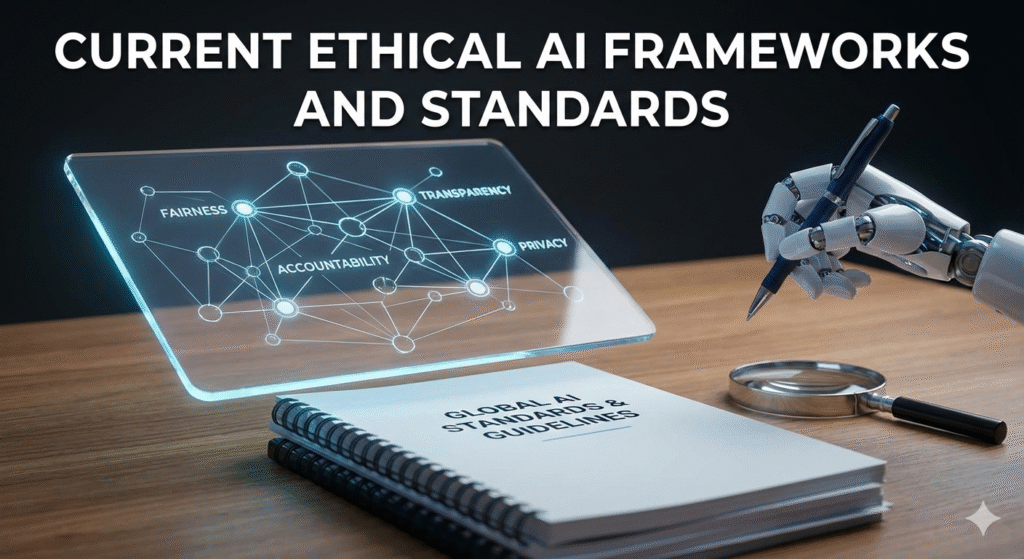
In 2026, several frameworks guide ethical AI implementation: The EU AI Act has established risk-based regulation with strict requirements for high-risk AI systems and prohibitions on certain applications deemed to pose unacceptable risks. National AI strategies increasingly incorporate ethics principles alongside competitiveness goals. Industry standards from organizations like IEEE and ISO provide technical specifications for implementing ethical AI principles. These frameworks represent growing consensus on core values while allowing flexibility in implementation approaches suited to different contexts and applications.
Challenges in Implementing Ethical AI
Technical Challenges
AI ethics implementation faces genuine technical obstacles. Measuring fairness across multiple dimensions simultaneously can involve mathematical impossibilities. Achieving transparency in complex neural networks remains difficult despite advances in explainable AI. Protecting privacy while maintaining AI system utility requires sophisticated techniques not yet widely deployed. These challenges require ongoing research investment and honest acknowledgment of current limitations rather than premature claims of having “solved” AI ethics.
Organizational Challenges
Even with technical solutions available, ethical AI governance struggles with organizational realities including pressure for rapid deployment that conflicts with thorough ethics review, insufficient diversity in AI development teams leading to blind spots, and lack of clear accountability when AI systems span multiple organizations and jurisdictions. Addressing these requires cultural change within technology organizations, not just new policies or tools.
Global Coordination Challenges
AI ethics cannot be solved within national borders. Global AI ethics faces challenges of divergent values across cultures, competitive pressures that create races to the bottom on ethical standards, and difficulties coordinating regulatory approaches while respecting sovereignty. International cooperation mechanisms are still developing, creating risks of fragmented approaches that complicate compliance and allow ethical arbitrage.
The Role of Stakeholders in Ethical AI
Technology Companies
Organizations developing AI bear primary responsibility for ethical AI development. This includes investing in safety research, maintaining diverse and empowered ethics teams, and prioritizing long-term societal benefit over short-term profit maximization.
Governments and Regulators
Policymakers must craft AI regulation that protects public interests without stifling beneficial innovation. This requires technical literacy, engagement with diverse stakeholders, and adaptive regulatory approaches.
Civil Society and Academia
Researchers, advocacy organizations, and affected communities provide essential perspectives on AI impacts and hold powerful actors accountable. Their independence from commercial pressures is crucial for honest assessment.
Individual Users
Everyone interacting with AI systems has a role in demanding transparency, reporting problems, and making informed choices about AI adoption.
The Future of Ethical AI Beyond 2026
Looking ahead, the future of ethical AI will likely involve more sophisticated governance mechanisms that can keep pace with rapidly advancing capabilities. We can expect increased automation of ethics compliance through AI systems that monitor other AI for fairness and bias, though this introduces its own ethical questions. The conversation will increasingly shift from whether to regulate AI to how to do so effectively across jurisdictions and application domains. Success will require sustained commitment from all stakeholders to prioritize human welfare alongside technological progress.
Conclusion
Ethical AI in 2026 represents both an unprecedented challenge and an extraordinary opportunity. By thoughtfully balancing innovation with responsibility, we can harness artificial intelligence to address pressing global problems while protecting fundamental human rights and values. This balance is not a one-time achievement but an ongoing process requiring vigilance, adaptation, and collaboration across sectors and borders.
The path forward demands that we neither embrace technological determinism nor succumb to excessive precaution. Instead, we must cultivate wisdom in deploying powerful tools we’re still learning to understand. The choices we make today about AI ethics will shape the technological landscape for generations, making it imperative that we get this balance right. Through continued dialogue, robust governance, and commitment to human-centered values, we can ensure that AI serves as a force for good in our increasingly interconnected world.


.png)
Comments
Post a Comment